The beginning of this is a post to my WHHS 1964 Message Forum.
Stephanie asked, "When did the conversations among friends become a recitation of everyone's health problems?" My friends call it an "organ recital."
And Steve acknowledged that he isn't afraid of death. I prefer Woody Allen's take on it. "I'm not afraid of death. I just don't want to be there when it happens."
Some years ago I took a class called "A Year to Live," based on the book by the same name. Each month we were instructed to perform one of the tasks that the author Stephen Levine suggests. One of the weeks we gave another member of the class something unique that we treasured, something that couldn't be replaced. I gave up a clock I had bought for my late uncle from Gump's Department Store in San Francisco, an item from a store that he liked so much. I salvaged it from his estate after he passed. Giving it away was a reminder that hearses have no room for suitcases, that in death we would be giving up everything we had in this life. On the day of the last class a bell signified that we had officially "died", and we were driven to Solano Avenue in Berkeley to wander among the stores and restaurants, noting that all of these cars, pedestrians, shoppers, buses and the like would still be doing this whether we were there or not. I went to a Starbucks and sat by myself in a chair under a window, looking at the line of customers ordering ventis and Grandes, the couples chatting, the laptops, and the carryouts. No one looked at me. I thought that if I quietly began removing my clothes they wouldn't look, either, unless someone needed a chair. NB. I didn't do it, but I did go across the street to an Andronico's Grocery Store restroom and questioned why I was locking the door. If I wasn't there, why bother?
Some years ago we rode a bus up park roads to the base of Denali in Alaska. (Nelson, so impressed that you climbed it). Jadyne and I asked to be let out of the bus on the soft tundra with our picnic lunch. there to climb a long hill and enjoy a warm Alaskan June day and my roast beef sandwich. I noticed that down below all the buses had stopped and noticed, too, that a grizzly bear on the road had captured their attention.
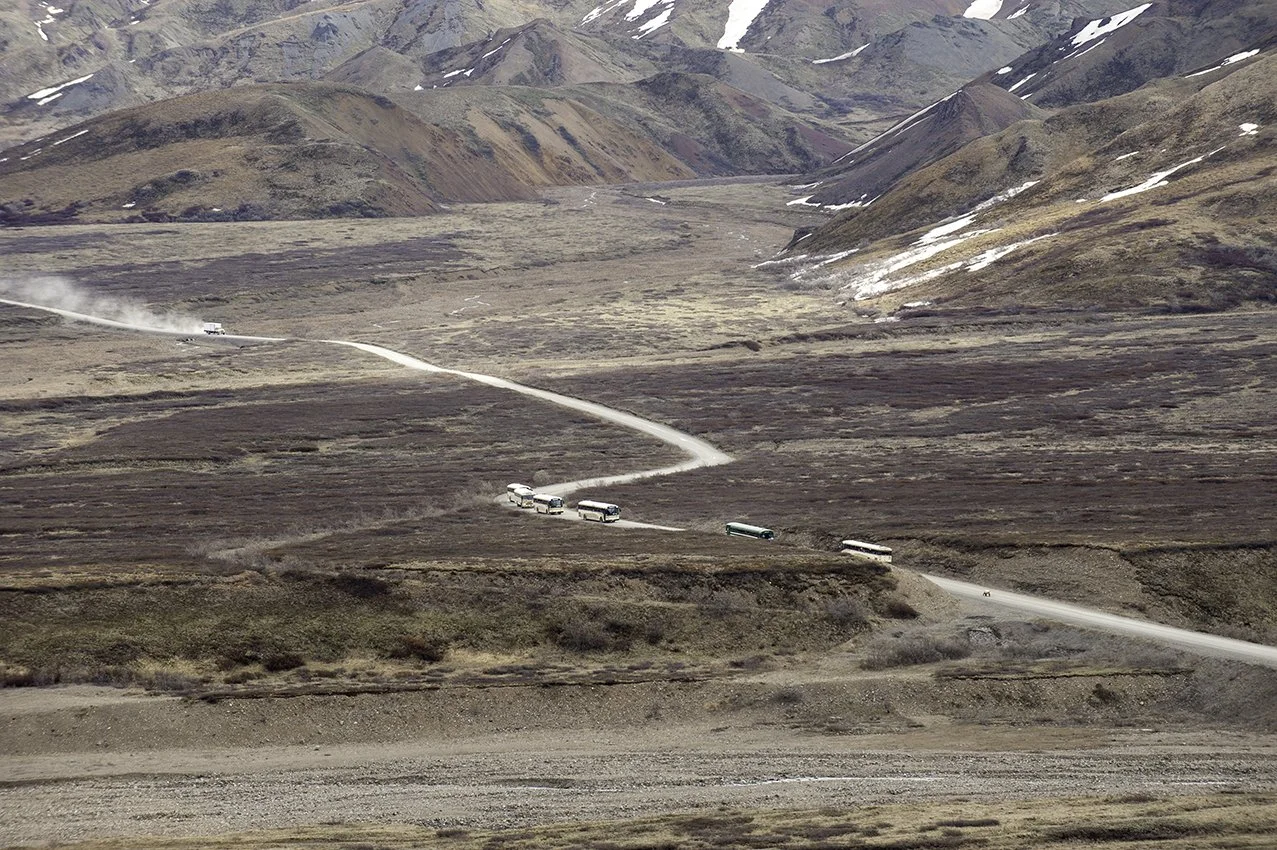
Perhaps you can see the little speck in the bottom right of this image.
I didn't think much of it at the time, but when the bear crossed the road and became the only living organism between us and the bus road my feelings changed a bit.
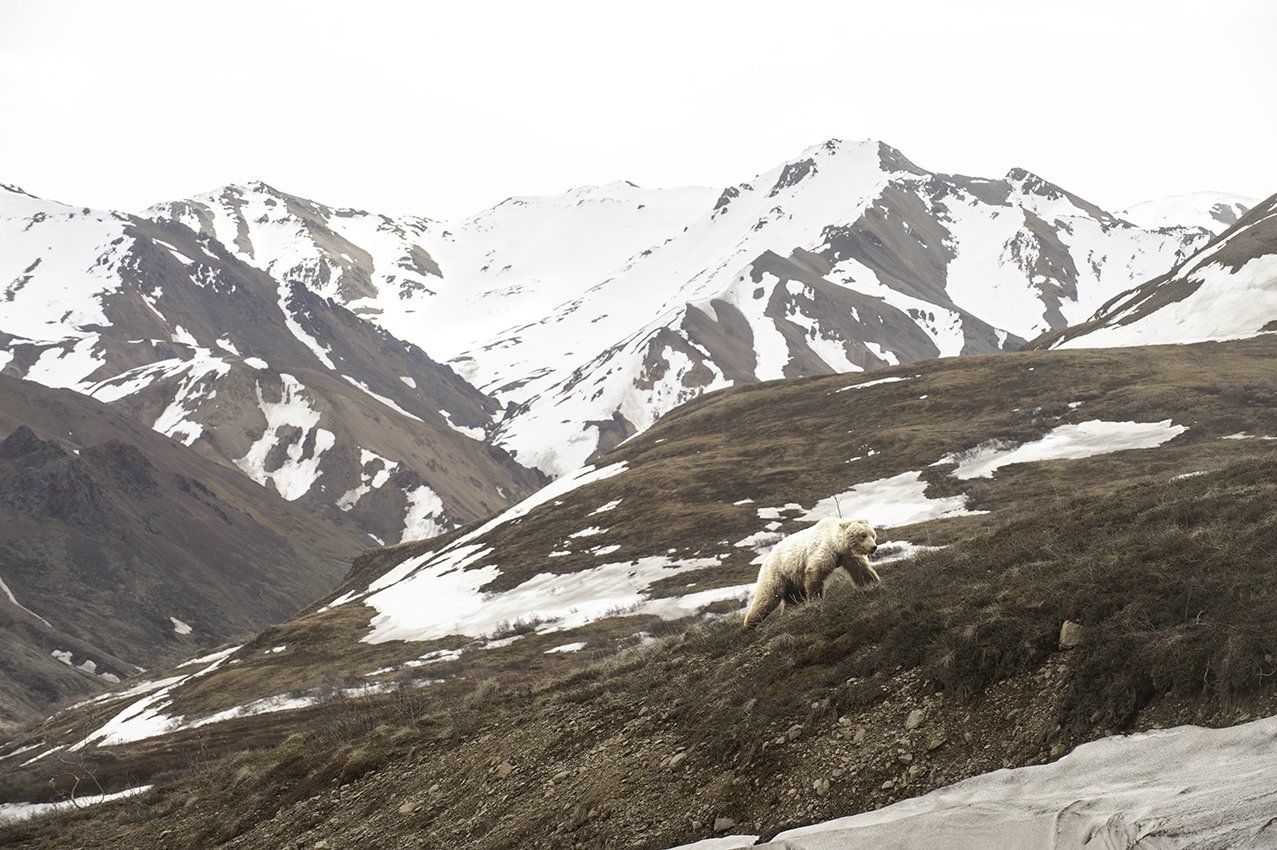
It was shortly before this that I decided that my roast beef sandwich could stay behind at the picnic site, that we had always been taught that it was good to share with others.
I looked at death the way I first looked at that bear, that there was, as the first photo reveals, nothing between it and me, and that it was on an inevitable path towards where I was having such a wonderful time, so enjoying my sandwich, but perhaps it was not interested in the sandwich at all.
I try to dress up the inevitable as best I can. In a cartoon (one of the New Yorker's, Stephanie, that I did understand) the figure of the hooded, caped black sickle-bearing death is leading a husband out of the apartment and down the hall. His wife calls after him, "Change is good!"
And me? Taking Stock, July 8th, 2026.
So here I am on the eve of my eightieth birthday, sitting at my computer listening to Segovia playing “Sevilla.” I met him once. Uncle Rowland was the President of the Cincinnati Symphony Orchestra (I think), and he introduced me to the maestro when I was about fourteen. “He plays guitar, too!,” Uncle Rowland said to Segovia.
So I’m pleased that I’m still here, having lived a couple of years longer than the average American male, showing little signs of infirmity or decay. My ideal weight is 150 lbs. I checked in today at 148. All my limbs function as intended, although the titanium left leg isn’t nearly as flexible as the right, and I struggle to put socks on or tie my shoes. Bending down, rising without using my hands from the floor challenges me. My vision is 20-20, as I’ve had cataract surgery in both of my eyes. I wear glasses for reading, and the coating on the lenses works almost as well as sunglasses. After septoplasty (long overdue) I can breathe freely through both sinuses. The advent of tinnitus was something to overcome, and I have. Besides, hearing cicadas during all my waking hours keeps me in touch with nature. My hearing itself is another story, but new hearing aids have been wonderful. I wear them from the moment I wake up until I climb into bed. I sleep close to seven hours a night, but my sleep schedule is all screwed up because I’m usually out by 8:30 and up by 3:30, or with luck sometime after 4. I have enough hair to have to pay for haircuts every two months or so. So that’s me at 80.
I’ve been happily married for more than fifty-six years, and am comforted and relieved to know and believe that Jadyne feels the same way. In those fifty-six years we’ve managed to become parents to three—Jason at 52, Jennifer, 50, and John, 47. And they, too, have been blessed each with a son and daughter. Jennifer and John are happily married, too, and we love and respect their spouses. Jason’s first marriage collapsed, but he’s now romantically interested in Sunny Lee, a woman we haven’t had any trouble admiring and loving, too.
The usual signs of mental deterioration are, at this point, not worrisome either for me or for Jadyne, who is a year younger. We do forget. We have to be occasionally reminded of some things that we’ve either forgotten or missed, but nothing out of the ordinary. We both have friends, meaningful relationships. One couple donated money to a food bank to honor my birthday tomorrow. We have good diets. We exercise more than most. We aren’t easily discouraged.
We both give back to our community. For me it’s Dorothy Day Homeless Shelter, where tomorrow I know I’m going to be feted with some birthday acknowledgment. Jadyne does that, too, and volunteers at a Thrift Shop several hours a week. We’re grateful for all the love and support we’ve received for so many years and are trying to pay it forward. As our President might conclude, “Thank you for your attention to this matter.”